 Aurum Prodest


By the numbers
12+
years on market
500+
projects delivered
50+
specialists
5yr
warranty
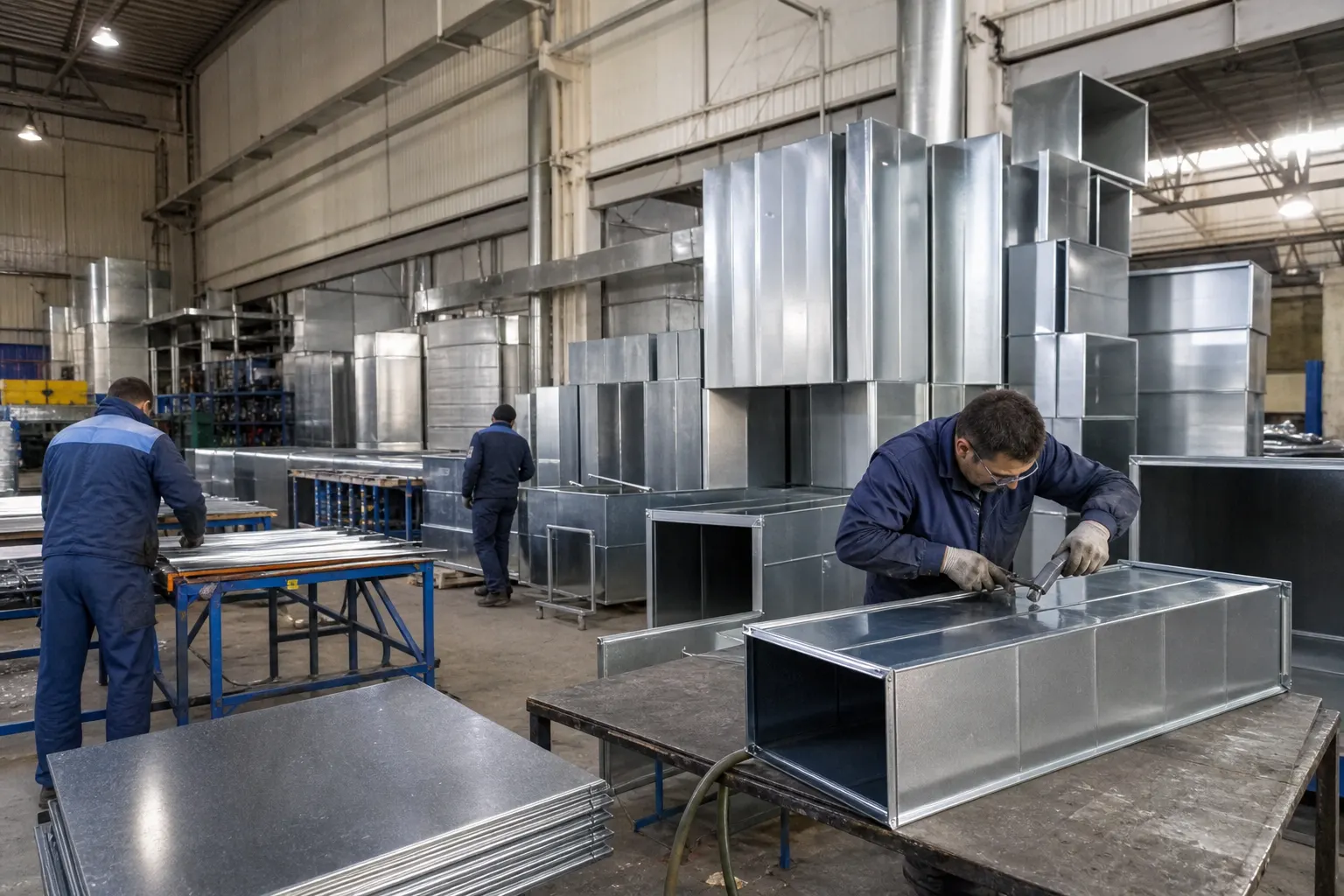 Workshop · 01
 Workshop ventilation is sized from process emissions, not from floor-area myths. Aurum Prodest designs industrial supply-exhaust and local extract: machine heat, dust, welding fume — each with hoods, filters and a 24/7 margin.
General roof fans without local capture smear contaminants through the volume while people still stand at the source. We start with an emission map: welding, paint, wood, food, ovens. Local extract takes 60–90% at the source; general ventilation holds the background and heat balance.
General roof fans without local capture smear contaminants through the volume while people still stand at the source. We start with an emission map: welding, paint, wood, food, ovens. Local extract takes 60–90% at the source; general ventilation holds the background and heat balance.
Summer heat in Uzbekistan is process + sun through roof lights + people. We size not only m³/h but supply temperature: cooled supply or evaporative cooling may be required, not “a wall fan”. Winter supply without a heater is a draught at the doors and condensate on trusses. Coil freeze protection is part of an industrial AHU.
Dust and chip ducts need velocity so material does not settle; welding needs spark-safe sections and a filter discharge. Filters — bags, cyclones, carbon — match the dust, not leftover stock. Roof discharge is checked against intakes so the shop does not breathe itself.
Live factories are fitted in night windows with temporary connections. In-house duct shop builds non-standard hoods in days. Hangers on trusses are load-checked — industrial duct is not an office box.
Handover: aerodynamic tests, workplace measurements if specified, VFD setup, mechanic training. 24/7 sites get a standby fan or 70% fallback. 5-year workmanship warranty; dusty and greasy circuits get their own service contract.
Office ventilation is sized from headcount, equipment heat and working hours — not from floor area slogans.
Restaurant ventilation is two jobs under one roof: pull heat and grease off the line, keep the dining room comfortable without kitchen smell.
Warehouse ventilation protects goods and people, not “air under the ridge for its own sake”.
Supply-exhaust ventilation is not “two fans at opposite ends of the building”. It is a balanced AHU: what you take from outside you throw away, filtered, heated, often with heat recovery. Aurum Prodest selects supply-only, extract-only o…
Ventilation design saves site rework: air change and pressure first, then duct sizes and purchase lists.
Ventilation succeeds on airflow design and ducts more than brand stars. Pros/cons of units we install often.
A brief comparison by class and use case — we match equipment to budget and site
Swipe the table sideways →
| Brand | Class | Pros | Cons |
|---|---|---|---|
 Systemair Systemair | Mid-range | Predictable AHU selection and kits | Pricier than pure value brands |
 Salda Salda | Mid-range | European mid for offices and F&B | Not the cheapest entry |
 Östberg Östberg | Mid-range | Quality fans, long life | Narrower “boxed AHU” range |
 Remak Remak | Mid-range | Central units for large networks | Heavier specs and cost |
 Vents Vents | Best value | Best value for typical networks | Less premium build reserve |
 Blauberg Blauberg | Best value | Accessible AHUs and light-commercial kits | Weaker mid on heavy industrial duty |
| Duty | often 24/7, flow margin |
|---|---|
| Local extract | 60–90% at source |
| Winter supply | heater + freeze protection |
| Dust ducts | velocity to prevent settlement |
| Supports | truss load check |
| Work warranty | 5 years |
Process hazards, heat, dust and 24/7. We design to exposure limits and hoods, not only headcount. A domestic AHU will not survive a shop.
A roof fan dilutes the room. It does not capture welding at the booth. People still breathe the source.
Often yes: stages, night windows, temporary links. A full stop is usually hours on a collector tie-in, not weeks.
There is no single number. Welding, paint and assembly are different. The figure comes from the emission map.
Extract-only pulls dust and cold through the doors. Supply plus extract is the normal scheme.
Different. Welding — cartridge/ESP. Wood — cyclone plus bags, sometimes recirculation. Do not mix circuits.
Ventilation installation — 12 cities. Crew dispatch, contract, warranty.
Capital · 500+ projects
Learn moreTourism capital · Hotels & malls
Learn moreAncient city · Heat up to +45°C
Learn moreFergana industrial center
Learn moreFergana Valley business hub
Learn moreRegional center · Healthcare & education
Learn moreKarakalpakstan · Extreme climate
Learn moreKhorezm · Trade & tourism
Learn moreOil & gas · Industrial facilities
Learn moreAgrarian region · Construction growth
Learn moreHottest city · Up to +50°C
Learn moreMining center · Energy sector
Learn more